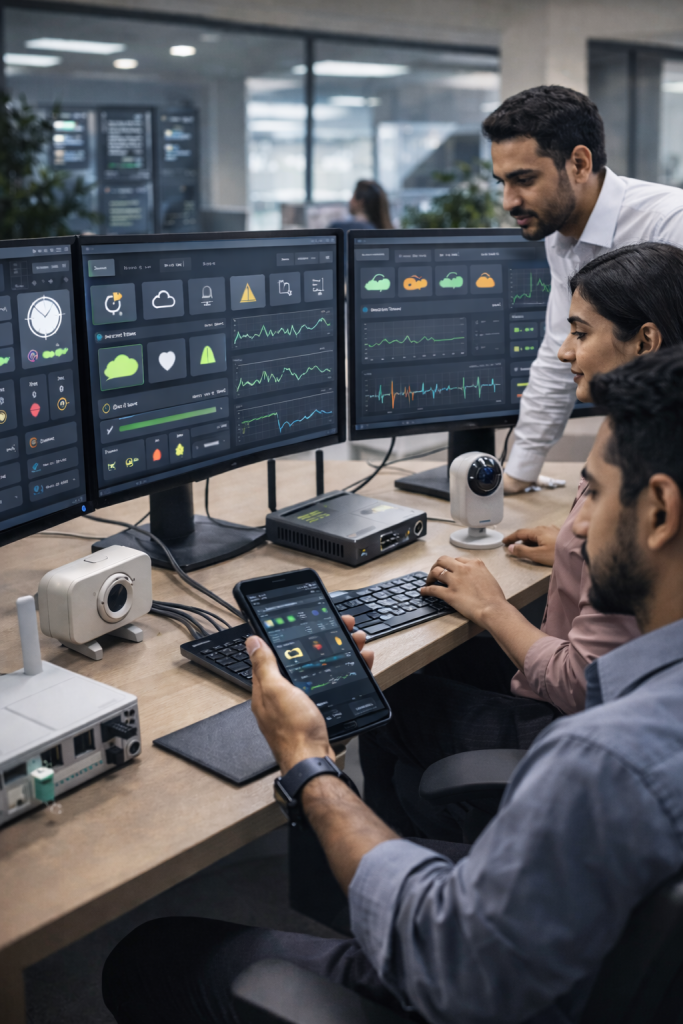
A stable design detects abnormal states, logs what happened, and recovers automatically. Watchdog handling, safe boot checks, and brownout recovery matter here. When the device stays stable, the cloud and dashboard can show data that users actually trust.
Connectivity that survives real networks
Connectivity needs a realistic plan. Many sites have weak Wi-Fi, unstable routers, or changing network settings. Cellular coverage can vary too, especially in remote areas. Therefore, the device should not assume a perfect connection. It should reconnect cleanly after outages and avoid constant retries that waste power and data. Local buffering improves reliability. When the connection drops, the device stores key readings and events. After the link returns, it uploads data in the correct order. This prevents gaps and keeps dashboards meaningful.
Case example: Remote pump monitoring during network loss
Consider a pump system at a remote site that reports flow and motor current to a dashboard. One night, the network drops for two hours. Without buffering, the dashboard shows missing history and the operator assumes the pump stopped. With buffering, the device logs flow, current, and start and stop events locally. When the network returns, it uploads the full history. The operator sees that the pump ran normally and avoids an unnecessary site visit.
Data quality that operators can trust
Data quality decides whether people keep using the dashboard. If dashboards show stale or wrong values, operators stop trusting the system. Good designs include basic validation and health indicators. The device can report last communication time, uptime, reset reason, and signal strength. These details help teams separate process issues from device issues.
Case example: Cold storage temperature “stuck” on the dashboard
Imagine a cold storage monitoring unit that tracks temperature and door status. One day, the dashboard shows temperature stuck at a constant value. If the device also reports sensor fault and last sensor update time, the team knows it is a sensor or wiring issue, not a cooling failure. That clarity prevents panic and speeds up the correct fix.
Alerts that reduce downtime, not create noise
Alerts should support action, not create noise. Too many alerts train users to ignore notifications. A reliable monitoring system uses clear thresholds, sensible delays, and event grouping so it sends one meaningful alert instead of repeated messages. It also helps if the alert includes a timestamp and a short status that explains what the system did next.
Remote control with safety checks
Remote control can add value, but it must be safe. Many systems allow remote start and stop, setpoint changes, or schedule updates. Every command should be validated and confirmed. Firmware must enforce limits and interlocks so remote commands cannot create unsafe operation. When firmware protects the system, remote control becomes trustworthy.
Testing that proves field readiness
Testing decides whether the IoT system will survive real conditions. Reliability testing should include long-run operation, power cycling, and repeated network drop scenarios. It should also test sensor disconnects and recovery behavior. If the device can recover on its own, it is ready for deployment. If it needs manual resets often, service cost rises and users lose confidence.
Closing
IoT & Remote Monitoring works best when the system stays stable, recoverable, and easy to operate. Reliable firmware, realistic connectivity handling, clean data validation, meaningful alerts, and safe remote control create a solution that performs in real field conditions. If you are planning IoT for an embedded product, start with reliability as the main requirement. That single decision improves uptime, reduces site visits, and makes remote monitoring a tool that people rely on every day.